What Phrase Is Repeated 9000 Times In Alhambra?
The Nasrid motto 'Wa la ghaliba illa Allah' appears thousands of times across the Alhambra's walls in Granada. What it means, where to find it, and why it was repeated so often.
Walk into the Hall of the Two Sisters in Granada's Nasrid Palaces and the walls do not leave you alone. Every available surface carries plasterwork carved with Arabic script, bands of it running above the doors, wrapping the arches, climbing the cupolas. Much of that script is the same short sentence, the Nasrid dynasty's motto, repeated so often across the complex that guides and guidebooks quote a figure in the thousands. The phrase is "Wa la ghaliba illa Allah", "There is no victor but God", and it is the closest thing the Alhambra has to a signature.
What Phrase Is Repeated 9000 Times In Alhambra?
The phrase is "Wa la ghaliba illa Allah", an Arabic sentence meaning "There is no victor but God". It served as the motto of the Nasrid dynasty, the Muslim rulers who built the Alhambra, and it recurs on walls, wooden ceilings, glazed tiles and ceramics throughout the monument. The widely quoted count of roughly 9,000 repetitions is a popular figure rather than the result of any study, while the palace's own body, the Patronato de la Alhambra, describes the motto simply as the most repeated of the roughly 10,000 inscriptions carved across the Nasrid Palaces.
The motto is usually shortened in speech to "la ghaliba illa Allah", dropping the opening particle. Both forms carry the same meaning, and both appear in the Alhambra's decoration. The sentence comes from the Quran, where a version of it appears in Surah Al Imran, and the Nasrids adopted it as a statement of political humility wrapped in religious conviction.
That double meaning mattered. The Nasrid emirs ruled the last Muslim kingdom on the Iberian Peninsula, and they survived as long as they did partly by paying tribute to Castile and playing rival Christian powers against each other. A motto saying "there is no victor but God" read as piety to a visitor and as a quiet reminder to the emir himself that no earthly victory, his included, was final. It was a diplomatic sentence as much as a devotional one.
The phrase is not the only text on the walls. Long poetic inscriptions, verses praising specific rulers, and foundation dates also run through the palaces, and a good guide can point out where the motto gives way to a poem. But the motto is the refrain, the sentence a visitor sees most often, and the one the Alhambra is famous for repeating.
Where In The Alhambra Can You See The Phrase?
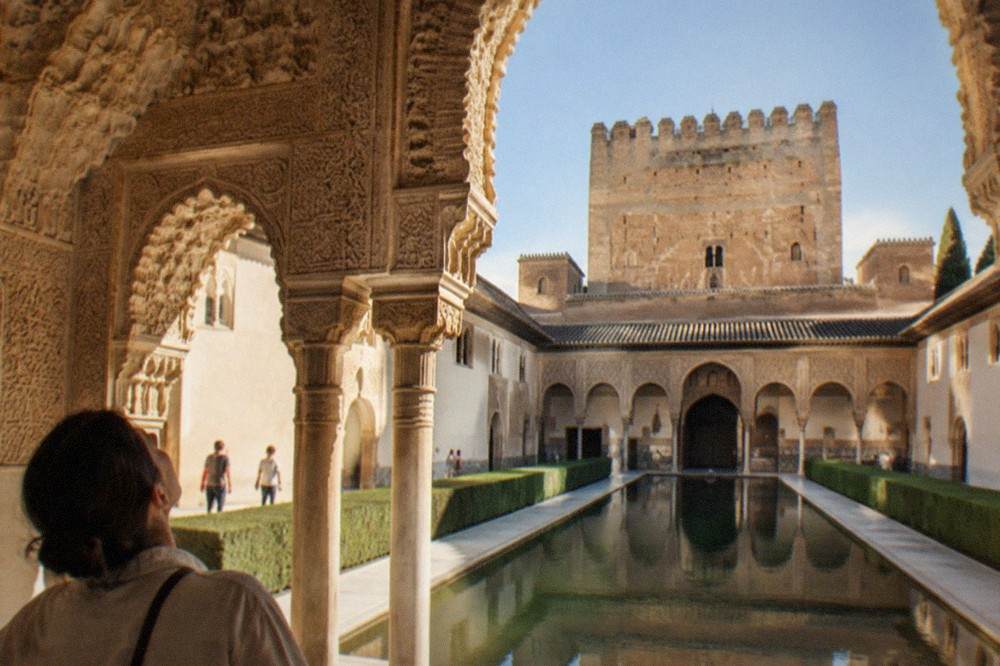
The densest concentration of the motto is in the Nasrid Palaces, above all in the Mexuar, the Comares Palace and the Lions Palace, where it frames doorways, fills the bands above arches and rings the famous muqarnas honeycomb vaults. The Hall of the Two Sisters and the Hall of the Abencerrajes carry it in long horizontal strips, and it also appears on glazed tile dados and on the wooden ceiling of the Hall of the Boat in the Comares Palace.
The Mexuar, the first hall visitors enter, sets the tone: the motto appears there alongside the formula of praise to the emir, so the visitor is greeted by God and king in the same glance. In the Comares Palace, the hall where the emir held audience, the phrase sits among the richest decoration in the complex, wrapped around the walls beneath the enormous cedar ceiling. The Lions Palace repeats it in the gallery arches that surround the fountain courtyard.
It helps to know what you are looking at. The script used for most of these inscriptions is cursive Naskhi, flowing and readable, sometimes interwoven into geometric knots. A second style, Kufic, appears on some of the tilework in more angular, harder-to-read forms. The motto in either style is short enough that once you have recognised it once, you start seeing it everywhere, which is precisely the point the count of repetitions makes.
Why Was The Same Sentence Carved So Many Times?
Repetition in Islamic palace decoration is deliberate rather than accidental: the motto worked as royal branding, as devotional text, and as a political statement addressed to the emir's own court and to visiting foreign envoys at the same time. Carvers repeated "There is no victor but God" because it declared who the Nasrids were on every surface a guest might rest an eye on, and because Nasrid design was built from repeatable units that made a short motto the ideal filler text between larger poems.
Nasrid craftsmen worked in modules. A wall was divided into horizontal bands, each carrying a specific kind of content: a tile dado at the base, a band of inscription above it, plasterwork panels and a vaulted ceiling above that. The inscription band needed text of a predictable length, and the motto, short and familiar, fit the band perfectly. When a longer poem was wanted, a poet supplied one, but the motto filled the gaps.
There is also a reading that goes beyond decoration. The Alhambra was a court in a fragile kingdom, and its walls spoke to two audiences at once. To the faithful, the phrase was Quranic humility. To the Castilian envoys who came to negotiate and demand tribute, it was a subtle refusal to concede that any earthly power, theirs included, held final victory. A sentence repeated 9,000 times is hard to read as an accident.
Can You Read The Inscriptions Without Knowing Arabic?
Yes, with preparation: the motto is short, uses a recognisable cursive script, and once a visitor has seen the phrase written out in Latin characters, most people can spot it on the walls within a few minutes inside the Nasrid Palaces. Recognising the full poems takes study, but the repeated motto, the word "Allah" at its end, and the emirs' names are the three things a non-Arabic speaker can learn to identify from a guidebook or a guided tour.
The practical route is to arrive knowing the shape of the words rather than the letters. Cursive Naskhi flows in connected strokes, and the final word of the motto, the name of God, is the easiest anchor point because it appears at the end of every repetition. Guides on Alhambra tours point the phrase out early in a visit, and after that most visitors report spotting it independently for the rest of the circuit. The rest of the planning pages sit on Things To Do In Granada.
A private guide changes the experience more than most people expect. The Alhambra, Nasrid Palaces, Generalife & Alcazaba Private Tour is led at the pace of the group, and the operator's live listing shows the current price and availability for the date you want. For visitors who prefer to go at their own speed, the Granada: Alhambra and Nasrid Palaces Ticket with Audioguide covers the same halls with recorded commentary. Check availability
How Does The Motto Fit The Rest Of The Alhambra's Story?
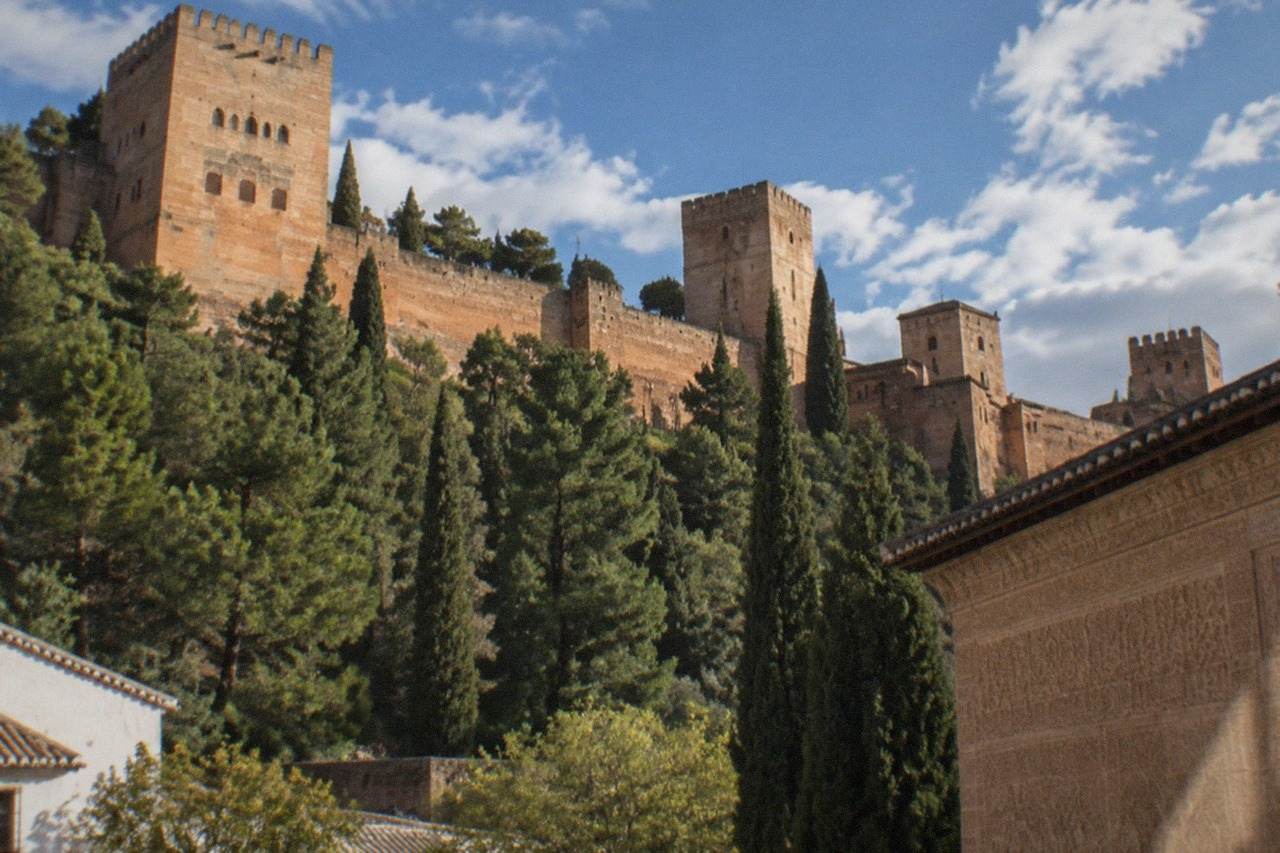
The motto belongs to the Nasrid period, the last chapter of Muslim rule in Granada, which ended when the Catholic Monarchs took the city. After the conquest, the phrase stopped being carved, but the palaces were preserved and later restored, so the inscriptions survived alongside the Renaissance Palace of Charles V and the Christian additions, which is why a visitor today reads two eras on the same hill.
The contrast is visible in the architecture itself. The Nasrid Palaces are dense, inward-facing, and covered in text; the Palace of Charles V, a Renaissance building of stone and classical columns, carries no calligraphy at all. Walking between them is walking between two ideas of what a palace should say about its owner. The motto belongs entirely to the earlier idea.
The survival of the inscriptions was not guaranteed. The palaces were lived in, altered, and in later periods fell into serious disrepair before restoration campaigns began. The plasterwork a visitor reads today has been cleaned, consolidated and in places remade, and the Patronato de la Alhambra continues conservation work on the decoration as an ongoing programme rather than a finished project. Readers who want the wider picture can start with our page on five facts about the Alhambra and the question of who actually built the Alhambra.
What Should You Know Before Visiting To See The Inscriptions?
The inscriptions are inside the Nasrid Palaces, which are the tightest-controlled part of the Alhambra: entry is by timed half-hour slot printed on your ticket, photo ID is checked because tickets are nominative, and the slot is strictly enforced while the rest of the complex, the Alcazaba and Generalife, can be visited more freely on the same ticket. The General ticket costs EUR 22.27 on the live official pages and often sells out one to two months ahead in peak season.
Planning around the sell-out reality matters more than planning around the calligraphy. Tickets release roughly three months in advance, online sales close the night before the visit date, and there is no reliable same-day online sale, so the choice of date is usually made weeks before the trip. Our Alhambra tickets guide covers the official channels, and the question of which ticket is best for the Alhambra compares the options.
The following table sets out what a visitor needs before standing in front of the walls.
| Practical point | What applies | Where it comes from |
|---|---|---|
| General ticket price | EUR 22.27 (live official figure) | Patronato de la Alhambra ticket pages |
| Nasrid Palaces entry | Timed half-hour slot, strictly enforced | Official ticket conditions |
| ID requirement | Photo ID checked at entry, tickets are nominative | Official ticket conditions |
| Ticket release window | Roughly 3 months ahead of the visit date | Official booking rules |
| Online sales close | 23:59 the day before the visit | Official booking rules |
| Peak-season sell-out | Often 1-2+ months ahead | Visitor analyses aligned with regulations |
Time inside matters too. The question of how much time you need to see the Alhambra is worth settling before you book, because reading inscriptions at any pace takes longer than a fast circuit, and the timed Nasrid Palaces slot cannot be extended. Visitors who want to linger over the decoration generally prefer the first entry slots of the morning, when the halls are at their quietest.
A private tour is also the most reliable way to hear the motto read aloud, in the halls where it was carved, rather than piecing the pronunciation together from a guidebook. The operator's live listing carries the current price, the meeting point and the available dates, and the booking terms on the listing cover cancellation.
Common Questions About The Alhambra's Repeated Phrase
What phrase is repeated 9000 times in Alhambra?
The Nasrid motto "Wa la ghaliba illa Allah", meaning "There is no victor but God". It was the dynastic slogan of the Nasrid rulers of Granada and appears on walls, tiles, ceilings and ceramics throughout the Nasrid Palaces, described by the Patronato de la Alhambra as the most repeated of the roughly 10,000 inscriptions found throughout the complex.
What does "There is no victor but God" mean?
It is a statement of humility before God echoing a Quranic verse, Surah Al Imran 3:160, without quoting it directly, and it was adopted by the Nasrid emirs as a royal motto. It declared piety to visitors while quietly reminding the emir, and the Castilian powers demanding tribute from him, that no earthly victory was final.
Where is the phrase easiest to see?
In the Nasrid Palaces, especially the Mexuar, the Comares Palace and the Lions Palace. The Hall of the Two Sisters and the Hall of the Abencerrajes carry it in long horizontal bands above the lower walls, and it recurs in the arches around the Court of the Lions.
Can you spot the phrase without reading Arabic?
Yes. The motto is short, written in a flowing cursive script, and ends with the most recognisable word in the sentence. Once a guide or guidebook has shown you the shape of the phrase, most visitors can pick it out repeatedly on their own for the rest of the visit.
Why did the Nasrids carve it so many times?
Nasrid wall design was built from repeatable decorative bands, and a short motto was the ideal text to fill the inscription band between the tile dado and the upper plasterwork. Repetition also served as royal branding and as a political message delivered to every audience that entered the palaces.
Do you need a timed ticket to see the inscriptions?
Yes. The inscriptions are concentrated in the Nasrid Palaces, which are the timed, nominative part of the Alhambra visit. Entry is by a specific half-hour window printed on the ticket, photo ID is checked, and the General ticket often sells out one to two months ahead in peak season, so book well in advance.
The phrase on the Alhambra's walls outlasted the dynasty that carved it, and that is the quiet point of the 9,000 repetitions: a sentence about the limits of victory is still being read, in a monument that changes hands but keeps its text, long after the last Nasrid emir walked out of its gates.