What Food Is Granada Famous For?
Granada is famous for free tapas with every drink, plus habas con jamon, pionono, Sacromonte tortilla and hearty Alpujarran mountain cooking. Here is what to order and where.
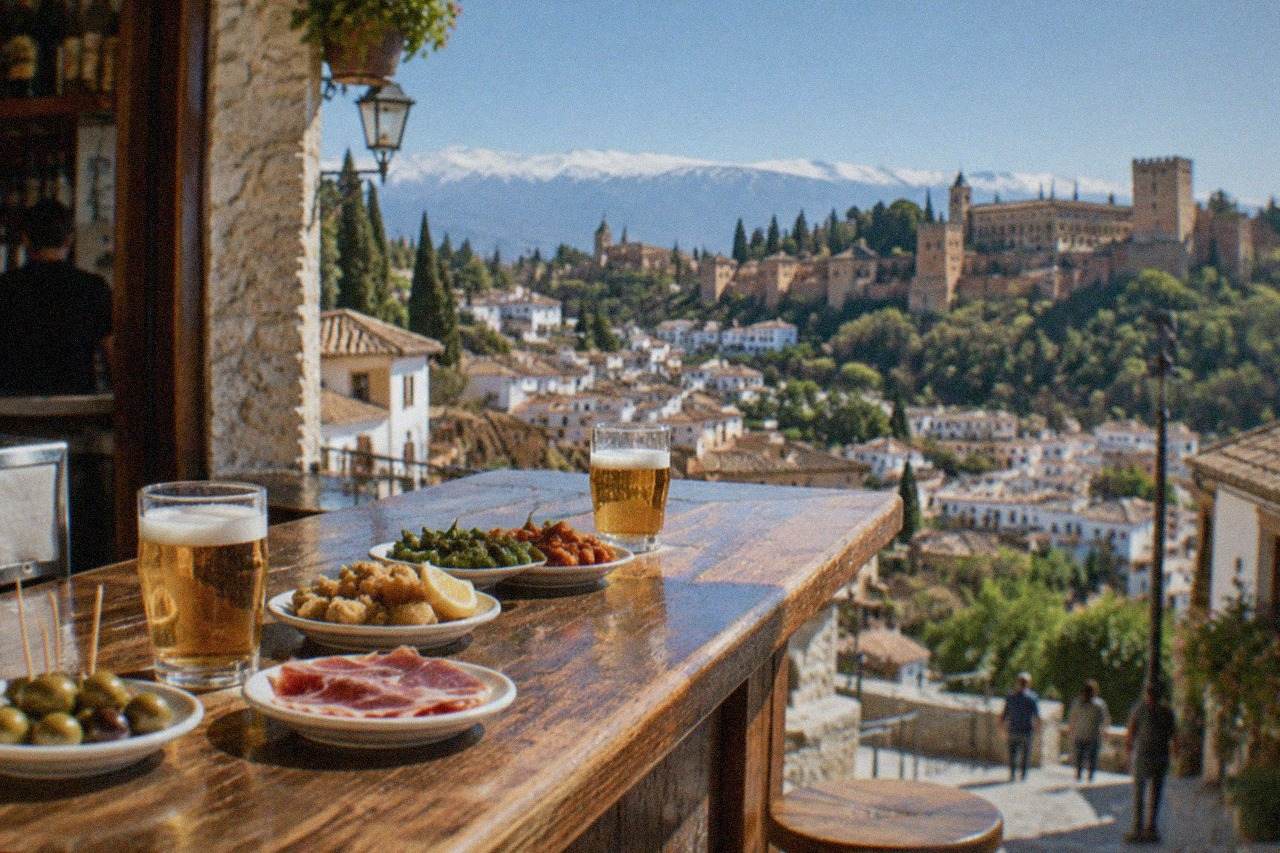
Granada is the Spanish city where dinner still arrives with your drink. In many traditional bars across the Albaicin, the Realejo and the streets around the Cathedral, ordering a beer or a glass of wine brings a small plate of food to the table without anyone asking for it, and 2026 reporting confirms the custom remains widely upheld as part of local identity even as some venues adjust portions or pricing. That practice, the free tapa, is the single thing most visitors arrive knowing about, and it shapes everything else on the plate here: portions are generous, bars are built for standing and moving, and a night out can be a full progressive dinner across four or five counters. But the city has its own dishes too, ones that exist because of its mountain hinterland, its Moorish history and its convents, and knowing them changes what you order. This page sets out what Granada is actually famous for eating, which dishes are worth seeking out by name, and how to eat well without drifting into the tourist lanes. For the wider sightseeing picture, the editors' companion piece on what not to miss in Granada covers the rest of the city.
What Food Is Granada Famous For?
Granada is famous for free tapas served with every drink, a custom still widely upheld in traditional bars in 2026, and for a core repertoire of local dishes: habas con jamon (broad beans with ham), the Sacromonte tortilla with brains and beans, piononos (a syrup-soaked cream-filled pastry from Santa Fe), remojon, and hearty Alpujarran mountain cooking including plato alpujarreno with lamb, chorizo and morcilla.
Each of those has a story attached. The tapa custom is the headline: it is widely upheld local practice rather than a legal guarantee, and some venues have adjusted portion size or pricing, so treat it as the norm rather than a certainty at every single bar. The dishes below come from three distinct layers of the city's history: the Moorish agricultural plain that supplied dried beans and broad beans, the Christian conquest era that left convents and their pastry traditions, and the mountain villages of the Alpujarras whose cured meats and stews flow down into the city's kitchens. Eating in Granada is therefore not a lesser version of Seville's tapas scene, it is a different thing altogether, and visitors who arrive comparing the two usually miss what makes the city distinct. The editors' guide to Granada food goes deeper on individual restaurants and neighbourhoods.
Why Is The Free Tapa With Every Drink Such A Big Deal In Granada?
Because it is the last large Spanish city where the custom still works at scale: a drink order in many traditional bars typically comes with a complimentary small plate, portions often increasing with subsequent rounds, and July 2026 reporting confirms the tradition remains standard practice in much of the city even as some venues adjust. It is local practice, not a legal requirement, and not every bar does it.
The mechanics matter for visitors. The tapa is not a menu item you choose in most traditional bars, it is what the kitchen sends, and it scales with the price of your drink: order the cheap beer and you may get a small montadito, order the better wine and the plate improves. A common pattern is to move between three or four bars in an evening, one drink and one tapa in each, which turns a night out into a walking dinner through the Albaicin or the Realejo. What the custom is not: guaranteed. Some venues have tweaked portion size or raised drink prices to cover it, and a few tourist-facing places have dropped it entirely, so the reliable move is to look for bars where locals are standing with plates rather than sitting with menus. The question of whether the custom survives comes up constantly, and the editors' dedicated answer on whether Granada still does free tapas tracks it in detail.
A guided tapas route is one way to short-circuit the guesswork. The Granada Tapas and Wine Small Group Tour, from $78 per person and rated 4.9 from 933 reviews over 3h30m, walks a small group through several bars with the ordering handled for you, which matters when the best free-tapa bars are exactly the ones with no English menu. Pairing it with a walk through the Albaicin and Sacromonte, such as the Sacromonte and Albayzin Neighbourhoods Walking Tour from $50, puts the food in its physical context: cave houses, flamenco and the bars tucked under them. Other pages covering the same trip are gathered on Things To Do In Granada.
Which Dishes Should You Actually Order In Granada?
Order habas con jamon (broad beans with serrano ham) as the signature local dish, the Sacromonte tortilla made with brains and beans if you want the historic one, piononos from Santa Fe for dessert, plato alpujarreno for the mountain influence, and ojuelas or roscos if you find a traditional bakery. Together they cover the city's Moorish, post-conquest and mountain layers in one eating week.
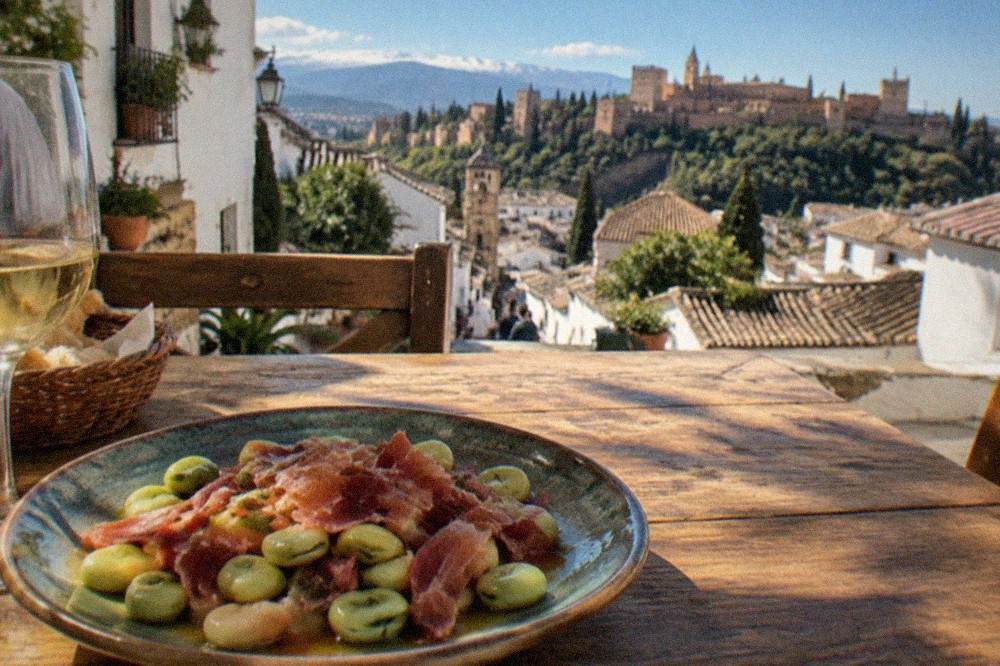
Habas con jamon is the plate most locals would name first: tender broad beans stewed with cured ham, a dish that exists because the Vega de Granada, the fertile plain around the city, grew broad beans for centuries. The Sacromonte tortilla is the city's most storied dish, a potato-and-egg tortilla traditionally made with brains and beans, historically served during the Romeria of the Sacromonte abbey, and still on menus in the cave restaurants of the Sacromonte, though many modern versions quietly drop the brains. Piononos are the pastry: small cylinders of sponge soaked in syrup, filled with cream, created in Santa Fe just outside the city. From the mountains comes plato alpujarreno, a heavy combination of lamb, chorizo, morcilla, egg and fried potatoes that reflects the curing culture of the Alpujarras villages, which the editors cover in the Alpujarras guide.
| Dish | What It Is | Where To Find It |
|---|---|---|
| Habas con jamon | Broad beans stewed with serrano ham | Traditional bars citywide, spring menus |
| Sacromonte tortilla | Tortilla with brains and beans, historic version | Cave restaurants in Sacromonte |
| Pionono | Syrup-soaked sponge with cream, from Santa Fe | Bakeries in Santa Fe and central Granada |
| Plato alpujarreno | Lamb, chorizo, morcilla, egg, fried potatoes | Mountain-style restaurants, Albaicin |
| Remojon | Orange and cod salad with eggs | Traditional bars, spring and summer |
A practical note on ordering: in free-tapa bars the kitchen decides, so the way to taste these dishes is to seek out the restaurants and tabernas that list them as raciones, full plates to share. The question of what traditional food to try in Granada has its own dedicated answer with more dishes and specific venues.
Where Do You Eat Well In Granada Without Falling Into A Tourist Trap?
Eat in the side streets rather than the main squares, and let two signals guide you: bars where people are standing with plates rather than sitting with laminated menus, and kitchens that send one tapa per drink without being asked. The areas that consistently deliver are the lower Albaicin around Calle Elvira, the Realejo, and the streets immediately north of the Cathedral, rather than the plaza-front terraces themselves.
The geography is simple. Calle Elvira and its side streets carry a dense run of free-tapa bars within a few minutes' walk of the Cathedral, and the Realejo, the old Jewish quarter on the Alhambra's western slope, has a more local, less visitor-heavy scene. The Albaicin climbs north of the Darro and mixes tourist restaurants with genuinely old tabernas, and the Sacromonte cave restaurants trade on flamenco as much as food, so treat dinner there as a show with food attached rather than a food destination. The famous tapas street question, which street exactly, has its own answer in the editors' piece on the famous tapas street in Granada, and the question of where locals themselves eat is answered separately too.
Timing matters as much as geography. Granada eats late by northern European standards, and bars fill from around 21:00, so a bar that is empty at 19:30 tells you nothing about its quality. Sunday lunch and Thursday evening are the local peaks, and the free-tapa custom runs strongest in the bars that are busy anyway, because the kitchen is already cooking.
Is Granada Food Different From The Rest Of Andalusia?
Yes, in two ways: the free tapa with every drink survives at a scale that Seville, Cordoba and Malaga no longer match, and the mountain hinterland gives Granada a heavier, more curing-driven repertoire, plato alpujarreno, jamon from the high pastures, and stews, that sits alongside rather than inside the coastal Andalusian tradition of fried fish and cold soups.
The comparison visitors most often make is with Seville, which has the larger and more famous tapas culture in terms of named bars and guidebook coverage, but Seville's tapas are paid, ordered from a menu, while Granada's arrive with the drink. The editors' head-to-head on Seville versus Granada covers the full travel comparison. Within Andalusia, Granada's food leans inland: the Alpujarras and Sierra Nevada supply cured meats and stews, and the Vega supplies beans and vegetables, where Malaga and the coast lean on fish. None of this makes one city's food better, it makes them different orders, and the visitor who arrives in Granada expecting to pay for each tapa will be pleasantly confused by the first plate that arrives unasked.
The eating calendar also shifts what lands on the plate. Spring brings the fresh broad bean harvest and with it the best habas con jamon of the year, autumn pulls the mountain stews back onto menus as the Sierra Nevada cools, and the big festival weeks, Cruces de Mayo in early May and Corpus Christi in late May or early June, fill the streets with temporary casetas serving grilled sardines and local wine. A trip timed to those weeks eats differently from a January visit, and the editors' answer on the best month to visit Granada weighs food against weather and crowds.
Common Questions About Granada Food
What food is Granada famous for?
Granada is famous for free tapas served with every drink, plus habas con jamon, the Sacromonte tortilla, piononos from Santa Fe, and mountain dishes like plato alpujarreno drawn from the Alpujarras.
Are tapas really free in Granada?
In many traditional bars, yes: a drink order typically comes with a complimentary small plate, often scaling up with further rounds. It is widely upheld local practice rather than a legal requirement, and some venues have adjusted portions or pricing, so it is not guaranteed at every bar.
What is a pionono?
A small cylinder of syrup-soaked sponge filled with cream, created in Santa Fe near Granada. It is the city's signature pastry.
What is the Sacromonte tortilla?
A traditional tortilla from the Sacromonte district historically made with brains and beans alongside potato and egg, associated with the Romeria of the Sacromonte abbey. Modern versions in the cave restaurants sometimes omit the brains.
Which area of Granada is best for eating?
The lower Albaicin around Calle Elvira, the Realejo, and the streets just north of the Cathedral carry the densest run of traditional free-tapa bars. The plaza-front terraces near the Cathedral are the likeliest places to pay tourist prices.
Is Granada food different from Seville's?
Yes. Seville's tapas are ordered and paid for from a menu, while Granada's arrive free with each drink, and Granada's repertoire leans inland toward mountain curing and stews rather than the coastal Andalusian tradition.
The short version: come for the free tapas, order the habas con jamon by name, save room for a pionono, and treat the bar-hopping itself as the dinner.